Healthcare
Read the medical record, even when it's handwritten.
Clinician handwriting that no two write alike, lab reports in every format, discharge summaries that run pages long. The records that break plain OCR, Upstage reads with full understanding of layout and context, so your clinicians can focus on care.


Every AI reads. Few read it right.
Upstage reads clinician handwriting and dense charts, and summarizes them per patient.
A VLM that reads handwriting, charts, and tables
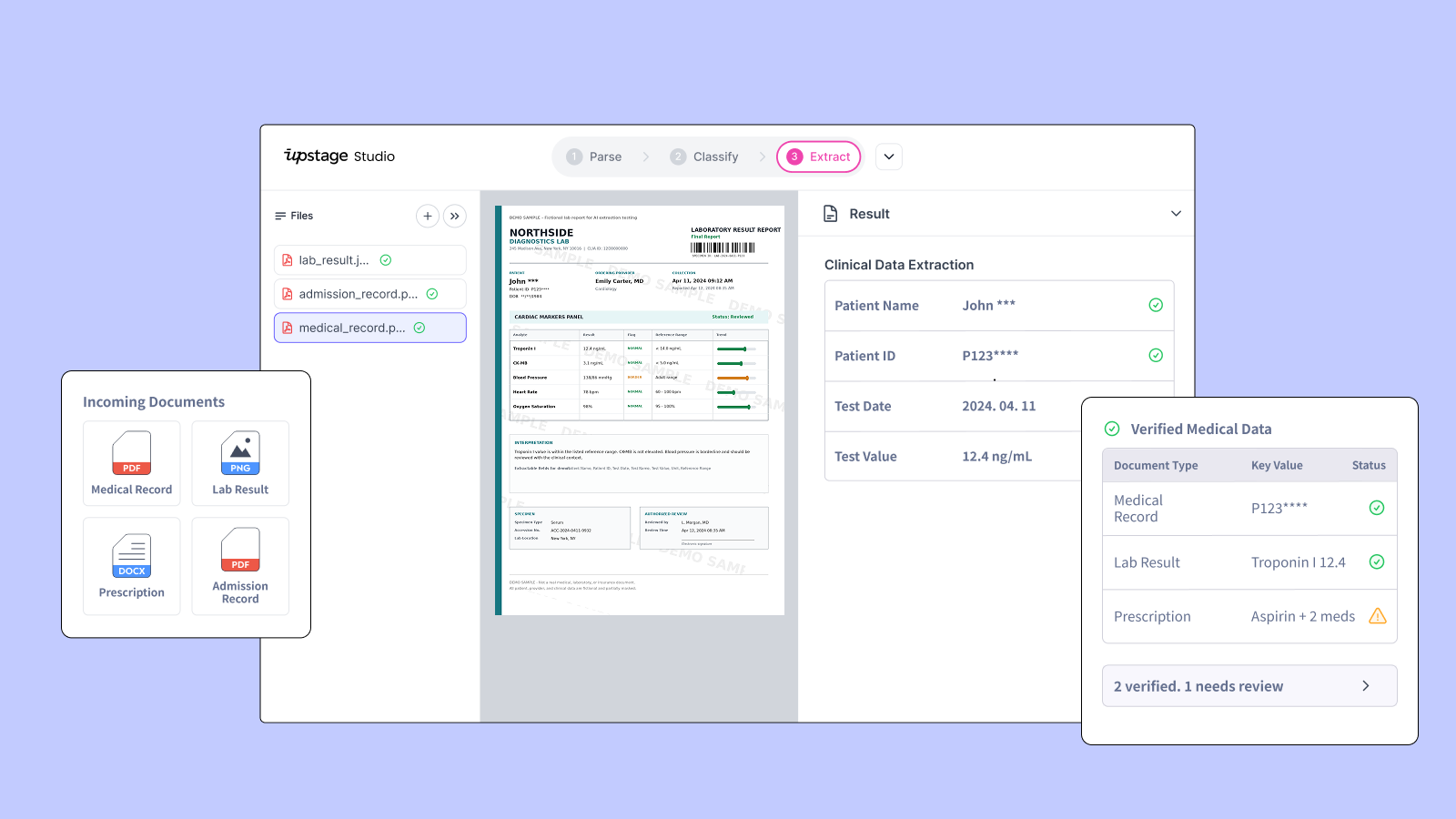
Plain OCR stalls on clinician handwriting and dense lab tables. Upstage uses a vision-language model that understands the structure and context of a medical record, so it pulls the right values even from poor scans.
Proven on real-world clinical documents
SOAP notes, lab reports, discharge summaries. In a paper-to-EHR pilot, Upstage extracted and summarized eight record types from live hospital data.
8 record types · paper-to-EHR pilot
PHI protection, HIPAA-ready
Runs in air-gapped or on-prem environments. PHI is automatically detected and redacted to meet HIPAA and your internal privacy requirements.
Beyond extraction: clinical summaries
It does not stop at pulling fields. It summarizes a patient's key clinical information, so care teams can grasp scattered records during transfers and consults without reading every page.
From a messy medical record to structured data

Pick the automation path that fits your team
Pre-built workflows are ready to go. Upload your documents, and structured data connects straight through.
Providers
HIM teams
Clinical trials (CRO/IRB)
Payers
Research
Clinical record extraction & summary
Pull key information from clinical notes, lab reports, and discharge summaries, and summarize it per patient to support faster, evidence-based decisions.
Paper chart to EHR digitization
Convert handwritten paper charts into EHR records and auto-summarize each patient's key clinical information, turning legacy archives into usable data.
Clinical trial operations
Collect and extract key data from protocols, consent forms, and investigator brochures to reduce regulatory submission burden and turnaround time.
PHI de-identification
Automatically detect and redact patient identifiers, so data can be shared and used for research safely.
From record intake to EHR, with no manual handoff
1
Documents arrive
From scan, paper, or EHR. Handwriting and mixed formats are fine.
2
AI reads and summarizes
It extracts and summarizes key information, and sends only low-confidence values to clinical review.
3
Results reach your system
Structured data flows into your EHR and research systems.
Fits into health systems and security reviews

Works with your EHR and systems
Connects via API to the EHR and health information systems your team already uses, with no rip-and-replace.

Deploy where patient data lives
Air-gapped or on-prem deployment. PHI is auto-detected and redacted to meet HIPAA and your privacy requirements.
Certified enterprise protection
Meets major security standards with advanced auditing and deployment controls.
Hand complex medical documents to Upstage.
Let AI handle the records, so your clinicians can focus on care.