

By Sam Gobrail, EVP, Solutions and Delivery, and Lucy Park, Co-founder & CPO, Upstage AI
Part 1 of a four-part series on what separates a vibe-coded document AI demo from a system an enterprise can run in production.
Across document-heavy enterprises, the same conversation is unfolding inside dozens of innovation and IT teams. Curious engineers point a frontier AI model at a stack of documents and, within a week, build something that works. The excitement is genuine, and it is earned. Leadership sees a demo, the team has real momentum, and for a while it feels like the hard part is behind them.
Then the curve flattens. The document AI accuracy that climbed so quickly in the first week refuses to climb further. Weeks of tuning turn into months with little to show for it, and the team that felt unstoppable starts to feel stuck.
This is the point when many of our customers come to us. The story is almost always the same, and we recognize it immediately because it is the story we lived by ourselves to build Upstage Studio.
.avif)
The fast start that fools everyone
The early speed is real. A prompt tuned against a handful of clean, representative documents can reach around 60-70% accuracy almost immediately. That result is what convinces everyone the rest is just more of the same effort.
But that early number only measures performance on the easy center of the distribution: the documents that look like the ones the prompt was written for. The real cost lives in the long tail, and the long tail is where production operates.
The real document universe dwarfs the demo set
The most important thing to understand about document AI is the gap between the demo set and the real world. A proof of concept runs against a few dozen documents that someone hand-picked. Production sends thousands of variations that no one selected: different layouts, different conventions, scanned faxes, handwriting in the margins, tables that span pages, and fields in places the schema never expected.
In insurance, for example, SOVs, loss runs, FNOLs, endorsements, and ACORD forms each carry years of accumulated edge cases, and in production, those edge cases are the norm. Every regulated, document-heavy enterprise has its own version of this sprawl.
This is why a single hand-tuned prompt plateaus. One prompt is a global instruction trying to cover a combinatorial space of formats. Each new variation is effectively a distribution shift, or a change in the data the system sees in production compared with the examples it was tuned against. Tuning the prompt to absorb that shift often means fitting more tightly to the last example, which is how a change that fixes one document quietly breaks another.
The plateau reflects the limits of a static approach applied to a moving, sprawling target, and the model itself is rarely the bottleneck.
Sustaining accuracy is the harder problem
Accuracy degrades quietly as the document set grows and drifts. A system that performs well today loses ground as new formats arrive, and in a manual build, no one notices until an error surfaces downstream.
What this problem actually requires is a fast iteration cycle that detects drift as it happens and corrects it continuously, before it shows up weeks later as a downstream error. The teams that break past the plateau treat document AI accuracy as a continuous process, with a way to keep improving as the documents keep changing.
That shift, from a one-time tuning effort to a continuous improvement loop, is the part an internal build almost never accounts for at the start.
How Studio approaches it
Upstage Studio is built around that shift, and it shows up in two capabilities that work together.
The first is a fast start. For the most common document workflows, a production-ready agent library covers complex processes out of the box, including invoice extraction, loss run extraction, underwriting submission review, and claims document handling. That means a team can begin from a working agent instead of a blank page.
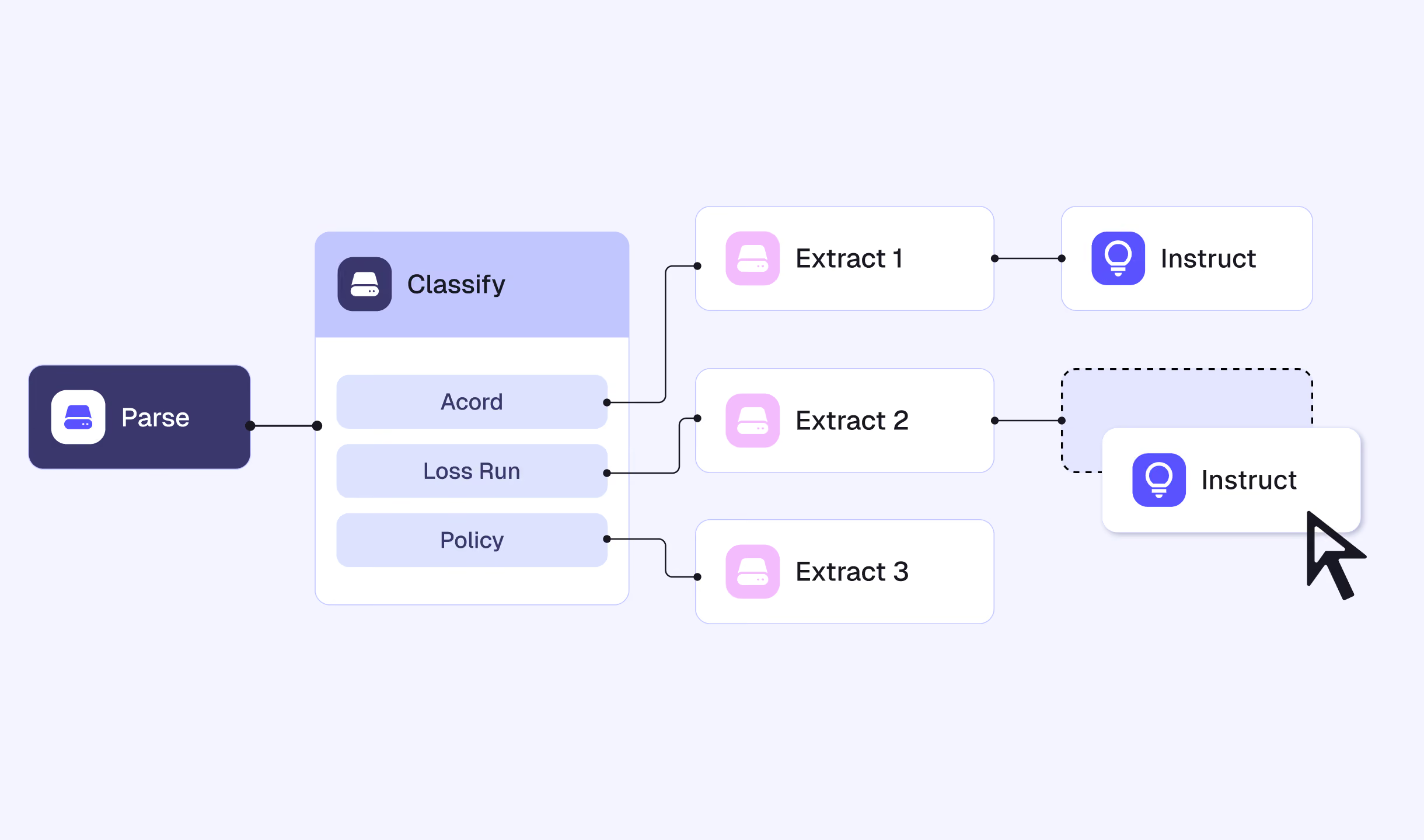
For workflows specific to a business, an automated agent editor builds the setup through chat and visually connects each step, making even a multi-stage workflow intuitive to assemble.
Underneath, one-pass extraction returns structured results in about a minute, and Quick Tune lets a domain expert define the outcomes they need and generate a working schema in minutes, with no prompt engineering and no engineering ticket. High accuracy is reachable on day one, and the people closest to the documents can reach it without waiting on the engineering backlog.
The second capability, and the one that matters more over time, is automated improvement. Studio measures accuracy at each step of the pipeline, parse, extract, and classify. It also attaches a confidence score to each step. When accuracy slips, the step-level view shows exactly where it slipped, so the problem can be corrected at its source and fed back into the system rather than chased across the whole pipeline by hand.
A falling step-level score, or a cluster of low-confidence results, is also the earliest sign that the document distribution is shifting. Studio uses those signals to drive an automated feedback loop, auto-tuning the extraction schema and learning from each correction, so accuracy holds as new document types and formats appear. The iteration cycle an internal team would run slowly and by hand happens automatically inside the system.
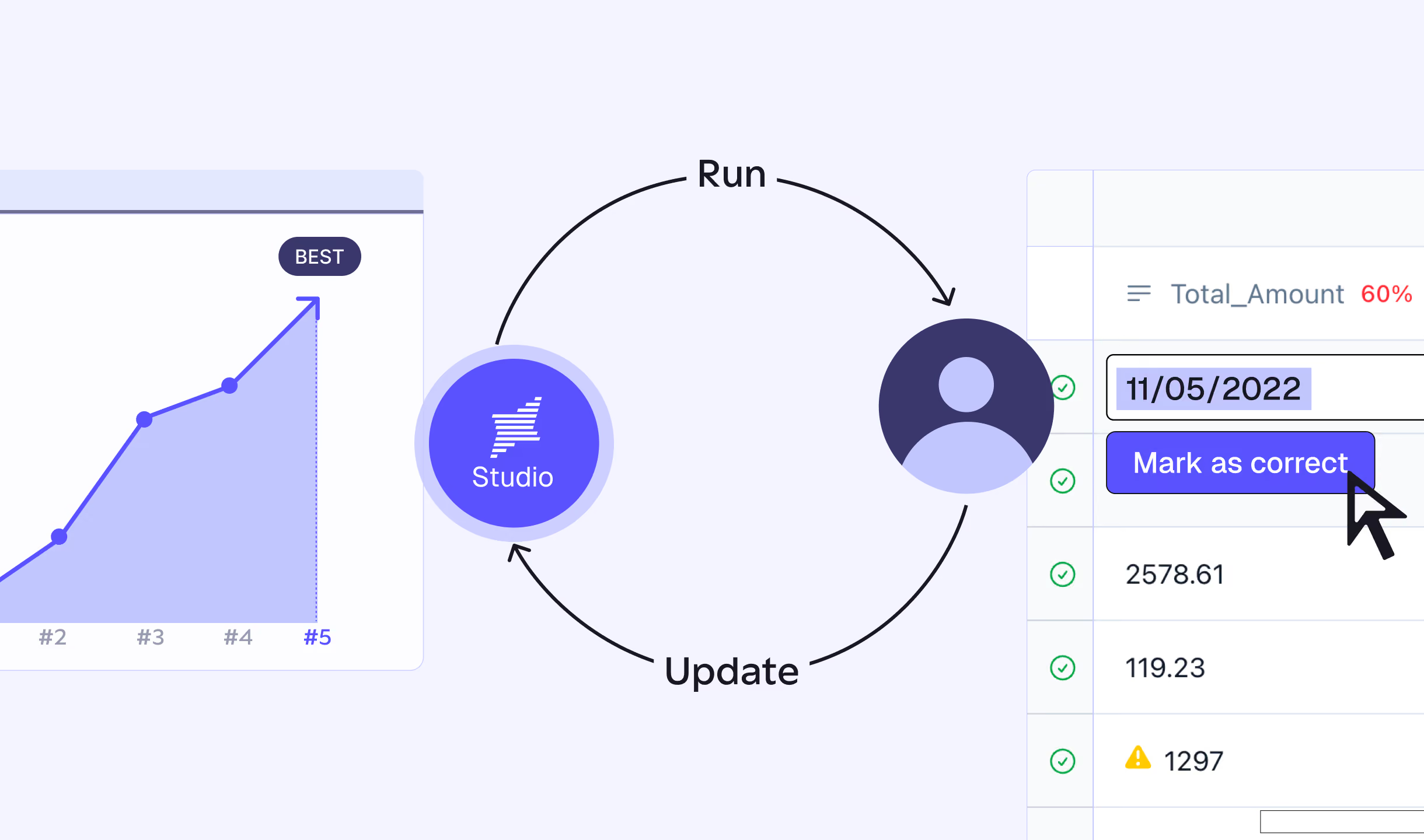
Together these capabilities produce sustained accuracy across diverse and changing document sets: a fast start to reach high accuracy quickly, and an automated loop to keep it there as the document universe expands.
In practice: In the Best Option case study, the team first built its underwriting extraction on a patchwork of a GitHub parser, DocuClipper, and ChatGPT, then replaced the entire stack with a single Upstage API, reaching 95% accuracy while eliminating the maintenance burden.
The decision underneath the decision
The accuracy trap is ultimately a question about where effort goes over the next year. A team can spend it running the iteration cycle by hand, chasing drift, rewriting prompts, and rediscovering edge cases one ticket at a time. Or it can treat that cycle as solved infrastructure and spend the year on the work that is genuinely unique to the business.
A completed proof of concept has already done the hardest conceptual part. It proves the opportunity is real. What remains is choosing an approach where accuracy keeps compounding as the documents change.
Sustained accuracy is the first thing a production system needs. Two others decide whether it can be deployed: whether the people who use it can trust its output, and whether its decisions can be explained and defended later.
See how the continuous improvement loop works in Upstage Studio, or contact us to talk it through on real documents.


