

.avif)
Across the insurance industry, 2026 is already being called the year of AI maturity. Carriers are building roadmaps for underwriting assistants, intelligent triage, and predictive pricing. The energy around these projects is real. But so is the risk of getting them wrong.
Because no matter how advanced the model or how sleek the interface, every AI initiative still depends on one simple truth: AI can’t transform what it can’t trust.
The foundation that everyone overlooks
Every insurer starts its AI journey with big ambitions: faster submissions, more consistency, fewer manual tasks. The problem is, those ambitions collide almost immediately with the messy reality of insurance data.
Submissions still arrive as PDFs, spreadsheets, and emails with wildly inconsistent formats. Loss runs, SOVs, and supplemental applications vary not just from broker to broker, but sometimes from day to day. The data that fuels underwriting is still deeply human, sometimes handwritten, rekeyed, and full of nuance that most AI systems can’t yet interpret.
So teams do what they’ve always done: they add another tool, another workflow, another validation step. It feels like progress. But in truth, it’s just new layers over old problems.
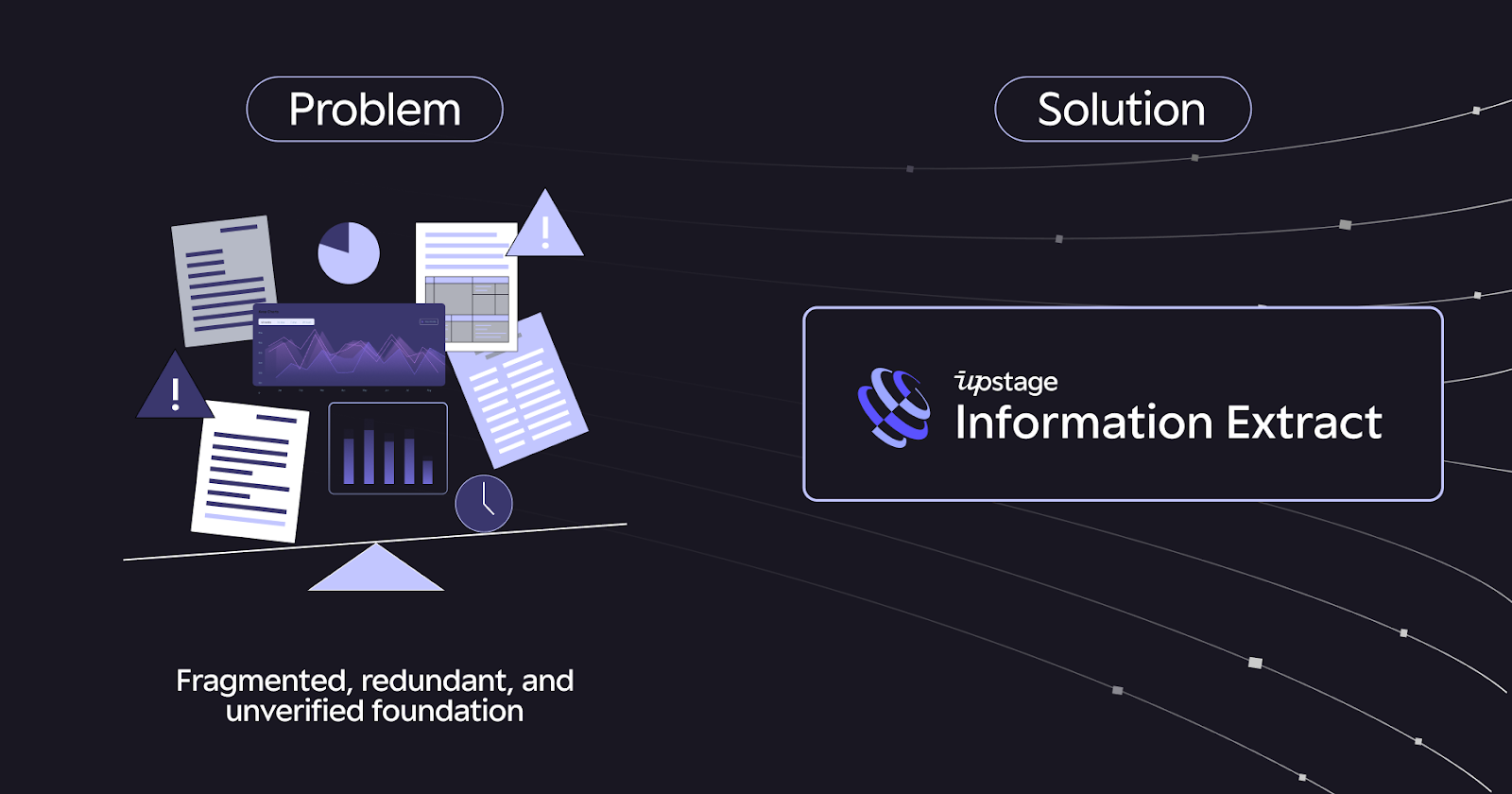
At Upstage, we see this pattern rise to the surface of almost every conversation we have. The technology evolves, but the foundation stays the same. It remains fragmented, redundant, and unverified.
That’s why Agentic Information Extract (Agentic IE) exists. It’s the system designed to finally fix the foundation.
Why every 2026 AI plan starts here
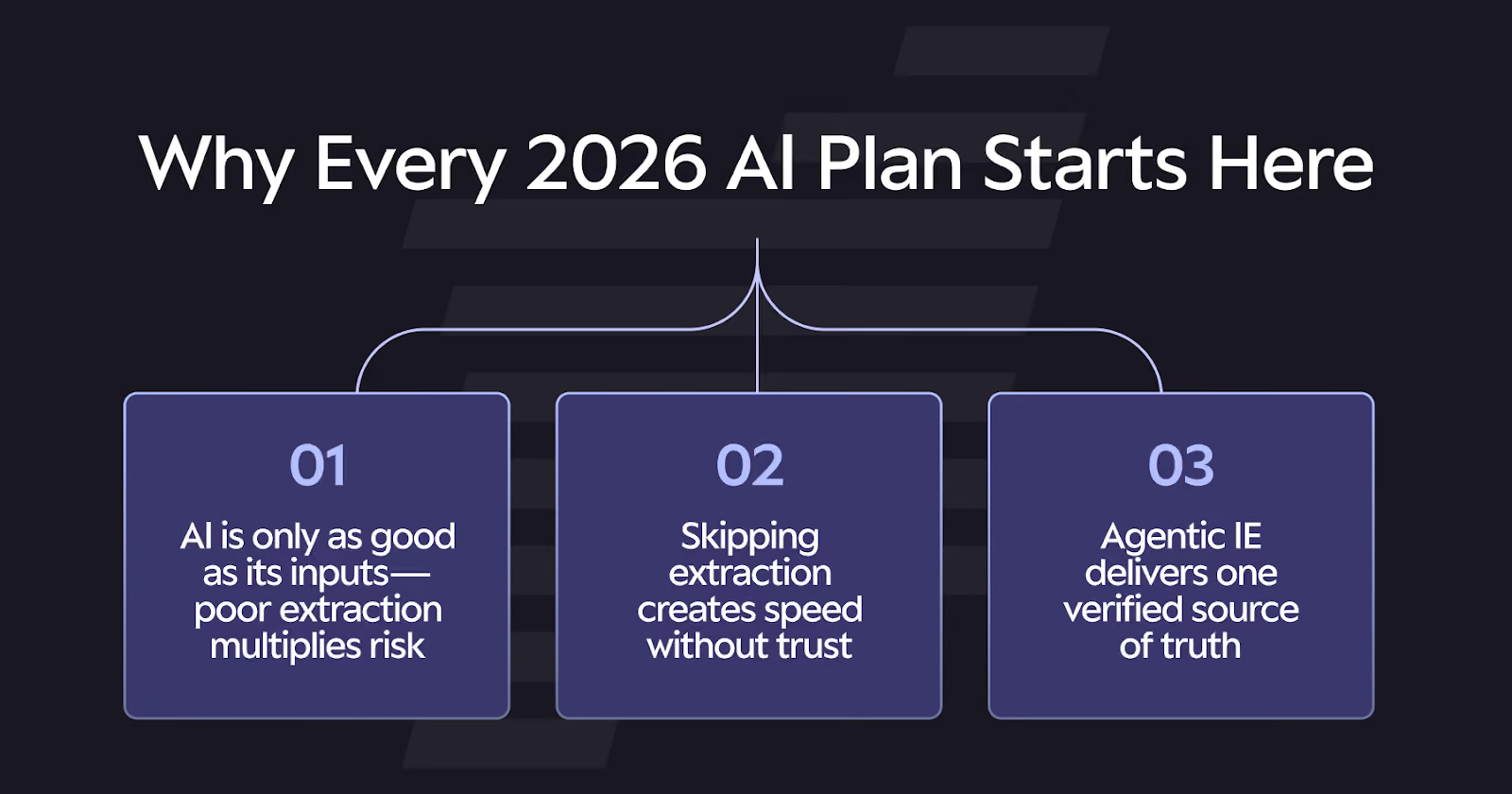
When leaders talk about AI transformation, the focus usually jumps straight to outcomes that are tied to faster underwriting, smarter recommendations, greater capacity. But without solving extraction, none of that happens.
AI tools are only as intelligent as the information they ingest. If a model learns from inconsistent loss histories or incomplete policy data, it will make mistakes faster than humans ever could. Those errors may be subtle, like a misplaced limit or a misread coverage term, but in underwriting, subtle mistakes compound into risk.
That’s the hidden cost of skipping extraction. Every unverified input becomes a future problem disguised as progress.
For Upstage clients, Agentic IE changes the equation. It doesn’t just pull text from documents. It reads, understands, and structures it so that every system downstream, from underwriting dashboards to predictive models, is working from one clean, verified version of the truth.
The result is not just efficiency. It’s credibility.
What happens when the foundation is fixed
When extraction is treated as a core capability instead of an afterthought, everything changes, not theoretically but operationally.
At Amwins, underwriters once spent hours reconciling invoice formats before review could even begin. With Agentic IE, that process now takes minutes. The team no longer debates whether the data is right; they focus on what to do with it.
At Best Option, the underwriting team had built a patchwork of tools that looked efficient on paper but created more friction in practice. After implementing Agentic IE, accuracy climbed above 95%, and manual review dropped by more than 80%.
These are not edge cases. They’re proof that when data extraction is solved, modernization stops feeling like a burden and starts behaving like an advantage.
When we talk with carriers mapping their 2026 AI plans, one truth keeps surfacing. The difference between systems that sound modern and systems that work modern always comes down to the quality of the input beneath them. The table below makes that difference visible:
Extraction isn’t another technical step. It’s the foundation that determines whether AI succeeds or stalls. This shift in foundation is what separates pilot projects that stall from programs that scale. Once data extraction is solved, every downstream initiative begins to compound in value instead of complexity.

Before the intelligence comes the understanding
For insurers planning AI initiatives in 2026, there’s enormous pressure to launch pilots, test copilots, and show visible progress. But speed without structure is a trap.
The real race is not about who builds the first underwriting assistant. It’s about who builds the first one that actually works consistently, confidently, and at scale.
Phase One of Upstage’s 90-Day Modernization Plan was built for this moment. Before any model is trained or any workflow is automated, we help insurers map where their data lives, how it moves, and what needs to be standardized for automation to succeed. Agentic IE powers that process, transforming unstructured documents into structured, reliable data that can finally support the intelligence insurers are investing in.
Every insurer wants to make better decisions faster. But speed without accuracy is just a faster path to the wrong outcome. Bad input will always create bad output, and no amount of innovation can outpace that truth. The future of underwriting will belong to the insurers who slow down long enough to get the data right, because that’s actually where real progress begins.
Upstage helps insurers start there. Agentic IE transforms messy, inconsistent inputs into the clean, reliable foundation AI needs to deliver results that last.
If your 2026 AI roadmap doesn’t start with extraction, it’s time to rethink the plan. Talk to Upstage about building it the right way.


.avif)